Tuesday, January 29, 2008

Rambo aka Stallone


Michael Sylvester Gardenzio Stallone is responsible for creating two characters who have become a part of the culture throughout the world: Rocky Balboa, the no-name boxer who overcame all odds to become a champion, and John Rambo, the courageous soldier who specialized in violent rescues and revenge. A dramatic actor and one of greatest action stars of all time, Stallone enjoyed phenomenal popularity and was the biggest movie star in the world with the Rocky and Rambo franchises during the 1980s.

Sylvester Stallone is a living legend, an international icon of machismo (through Rambo franchise) and a never say die fighter (through Rocky franchise). Rambo was a kind of no-nonsense James Bond, a very different kind of one-man-army, although equally effective. Rambo franchise brought guerrilla warfare to the forefront of cinema throughout the world. The name has become an eponym for a tactic of military aggression and extreme violence.

Rambo (The fourth in Rambo franchise) is exactly what you expect it to be. John Rambo is back, albeit this time fighting on his own conviction. And Stallone does exactly to the character which he did so successfully in the earlier three movies - Show the human side of John Rambo, despite him being a furious killing machine (as envisaged by the creator of the character David Morrell in his novel First Blood)
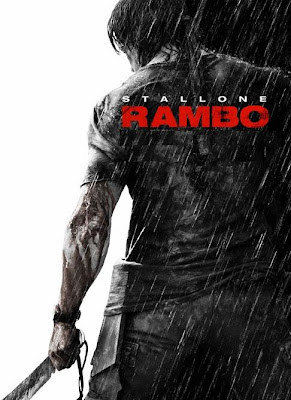

As for the latest Rambo, John is aged, living quitely, alone, but is not at peace with himself. He is shown in the film unable to come to terms with his owm grotesque existence. Anyway, John looks damn good ( Hats off to Stallone for maintaining the physique at an age of 61).

He drops off some Colorado based Missionaries off the coast of troubled war zone, and goes back to find and rescue them when the father of a girl comes asking him of their whereabouts.
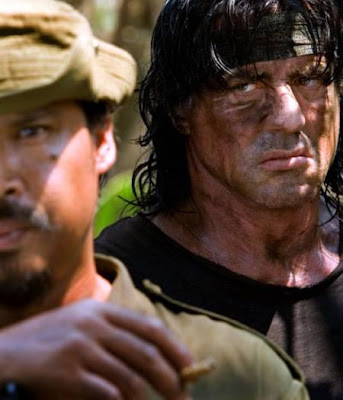

The movie disappointed me in some cases. The fact that no country was involved took the intensity out of the fights (something which can only be felt when nationalist cause is present). In most part, Rambo doesn't even fight with local rebels (a trademark of Rambo franchise hitertho), but with a group of hired mercenaries.

Overall, it's a very short movie, with hardly any story plot. It gives a couple of lines which could become cult feature of the Rambo franchise...

"Killing is just as easy as breathing"

"Live for nothing, or die for something"


Stallone actually got in touch with United Nations to zero in on the location of his story. Some place where human rights violation, civil war, poverty, hunger and disease prevail, and more importantly - a place about which the world doesn't care to know. He got his answer - BURMA.
"Black Hawk Down" and "Hotel Rwanda" brought the world's attention towards the Somalian war and the Rwandan Genocide respectively. I hope RAMBO does something similar for Burma.

So, go on and watch the movie, especially on the big screen... it's worth your time. It's the last chance to see Rambo in action, to give a farewell to a cinematic icon.


I also found few facts about Stallone:


1. Stallone made the city of Philadelphia an international tourist attraction with the Rocky Steps. His incredible popularity there has led to a statue of his Rocky character being placed permanently near the Philadelphia Museum of Art as a cultural landmark.

2. Birth complications caused partial paralysis in parts of Stallone's face, resulting in his signature slurred speech and drooping lower lip.

3. Stallone made his film debut with the lead in a 1970 hardcore pornographic film, Party at Kitty and Stud's. He was paid US$200 for two days work. The movie was edited and released later on to cash in on Stallone's fame. These releases were re-packaged under the names of Italian Stallion (taken from Stallone's nickname and a line from the film) and Cocky (a pun on Rocky).

4. Rocky was nominated for 10 Academy Awards in all, including Best Actor for Stallone himself.

5. The Rocky and Rambo franchises at the end of the decade of 80s were billion dollar franchises internationally.

6. The original Rocky was the most profitable entry of the series, with a budget of US$1.2 million, grossing US$117.1 million.

Tuesday, January 22, 2008

Crash Crash Crash !!!


Capital markets without losses is like religion without hell

Ouch !!! It hurt us bad, I mean , all of us.

There were an unprecedented abundance of ambulances on the road. ICUs were filled with patients complaining chest pain, and ECGs were running all around.Few people were arrested on charges of attempted suicide, trying to jump from a building. And to nobody's surprise, the building housed offices of several brokers. Telephone networks faced congestion...

Now Now Now, I don't know if any of it is true. These are all rumors I heard throughout the day, as our markets slipped, and kept on slipping. This was the first time I saw everyone in office (I mean everyone) clicking ferociously, again and again, just to check the current status. Still, I got a sense of deja vu, and realised this kind of maniac clicking happens everytime India plays cricket, where everyone wants to know the score.

I could sense the gloom spreading around. Nothing seemed right. Lunch tasted worse. Coffee wasn't hot enough. Presentations and demos went bad, and people left early.

Even the unceremonious ousting of Ganguly (and Dravid) from ODI squad touring Australia wasn't discussed, and take my word on this, you have to be in Calcutta for a while to understand the importance of it.

So, how the hell did this happen?

It all started with the outbreak of subprime mortgage crisis in US.
As US economy has been on an upswing for several years in a row, banks were giving large sums as loans to risky consumers (Lower credit score), charging them higher interest rates. The consumers paid the EMIs in a booming ecomomy, banks got richer by higher rates they charged on loans, and everything was hunky dory.
But as consumer sentiment lowered, with other troubles like unemployment and inflation surfacing, recession started to set in. The risky consumers now began defaulting on their loans, and banks got the authority to sell off the client's assets. But there was a simultaneous recession in US housing market as well, and so property valuations plummeted. This made balance sheets of most US Financial giants go RED. Deep RED, in fact. (Remember the fourth-quarte Citigroup Loss of $9.83 billion !!!)

But how the hell does this affect the whole world ???

There are two reasons:

1. The US Consumer has driven the global economy for quite some time now. But with the dollar falling, so much excess liquidity in the markets, it was only a matter of time before US consumer went bust.

2. The Banks in US traded the securities against loans throughout the world. These loans included the ones which are now the core of the US subprime crisis. Hence, the ramifications around the globe.


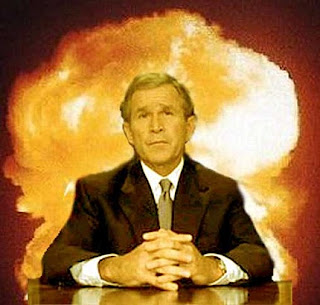
George Bush's plan for "direct and rapid relief " for the battered U.S. consumer arrived after the bloodbath in US markets; the price tag = US $ 150-billion through tax cuts. It has been greeted with a large dose of skepticism. Why this kind of a bailout in a free market economy? After all, borrowers weren't forced at gunpoint to take out loans they couldn't afford and lenders weren't obliged to lend to borrowers they knew couldn't afford it. It was greed all along, and now theey are paying the price. In that case, why should investors, future homeowners and potentially taxpayers pay for this sheer unadulterated greed on both sides, through higher costs and interest rates? And anyway, after this much shit, do they expect the US consumer will spend all the extra money from lower taxes on buying stuff rather than saving it???

BACK TO INDIA
Mayhem broke in India as it did everywhere else. But another problem is lurking behind the scenes as this storm takes it's toll.


A free fall in shares wiped off the combined market cap, of all the companies listed on the Bombay Stock Exchange (BSE), to the tune of a staggering Rs 6.7 lakh crore on Monday. While the Sensex has nosedived over 3,000 points in the past week, the consistent fall has seen an erosion of nearly Rs 12 lakh crore in Mcap to Rs 59.4 lakh crore during the period. It had taken almost three months to generate this amount of wealth in the market.

FLASHBACK
In July 2006, the National Stock Exchange had issued a circular to brokers asking them to submit an auditor’s certificate on the ownership of the shares pledged by them with the exchange. The policy was essentially to ensure that brokers do not misuse the funds of their clients.


BACK TO THE FUTURE
As markets plunged on Monday, brokers panicked and started pledging shares of their clients with the exchanges, in order to meet their own margin requirements. Now, this is in violation of NSE norms, which state that a broker cannot pledge share of his client with the exchange, without the client’s consent.The standard procedure states that Investors have to deposit margin money with their brokers before placing an order to buy or sell shares. The amount of margin to be paid depends on the value of the transaction. The investor can fund the margin requirement through a combination of cash, bank guarantee and shares. It is up to the broker as what percentage of the margin funds he would be comfortable accepting in the form of shares.The fall in the last two sessions has been particularly severe, and there are fears that quite a few clients may default on their commitments to the brokers. This in turn, could spell for the trouble for the broker as he/she has to make the pay-in to the exchanges even before he encashes his clients cheque. Now as these brokers default on their commitments, these shares will be liquidated by the exchange. But these are client's shares, brokers can't do this; its illegal.

So, when this dust settles, there will be another crisis to sort out. SEBI has its hands full, especially after athe whole P-Note saga in past few months. Everyone knows this is short term, and we'll be back on track within 3 - 4 months.


~~~~~~~~~~~~~~~~~~~~~~~~~~~~~~~~~~~~~~~~~~~~~~~~~~~~~~~


With this blog I have completed my half century. Yeah, 50 posts.

~~~~~~~~~~~~~~~~~~~~~~~~~~~~~~~~~~~~~~~~~~~~~~~~~~

Sunday, January 20, 2008

My tryst with the Gym...


It's been over a month now ... I have been going to GYM. Yeah.

So, why am I even writing about this?

I had been feeling uncomfortable about the fact for quite some time that all I do nowadays is sit and work. Sometimes, days pass at a strech without me breaking sweat. I've never liked this.
Gym as an option cropped periodically in my head.

Why did I finally do it? Simply because I always wanted to do it, but was always lazy enough to give it a pass.

But circumstances change everything.

About a month ago, I desperately needed a break from my routine life, and that is perhaps the only reason I went to the gym.

I've learned few interesting things first hand. Once you doll out the obscene amount of money, you kick your lazy demons aside. So guys, if you want to go to gym and have some motivation, try this philosophy; paisaa fek, tamaashaa dekh.

Once you go, the environment tells you how inadequate your body is; how self damaging your lifestyle is. You can actually feel that enthu building. It depends from person to person how long this enthu lasts. I’ve personally seen the duration last from a few minutes to weeks among individuals. There is only one way to find out. Do It.

So, after one month, what is the change in my life ???

1. I've gained weight. And more importantly, I've gained it the right way. It's all muscle, no fat.


2. The Beer belly is smaller now (maybe coz I'm drinking less as well).

3. I have become diet conscious; I make it a point never to miss breakfast, and to eat fruits and salad compulsarily everyday.

4. There is still no visible change in my body, but I can feel the muscles tightening up.

5. I don't go out on weekdays after office now. It's office, followed by Gym, and then I'm home. It has become a pain in the ass of some of my good collegues with whom I loitered aimlessly in malls etc untill about a month ago.

6. I unknowingly speak in terms of protein, fat, carbohydrate, cholestrol (As pointed out by my friends)

7. I've find it very interesting to hold conversation with other GYM guys regarding exercises, schedules, etc, and these conversations strech far too long.

All in all, I love it. It has been a forced change in my life, but I'm glad that I forced it on to myself.


So, I say, please try the gym, at least for a month. Have this experience - it's unique.

PS:
My next mission is to start learning Guitar seriously (Haven't started yet). Hope it happens soon...

End Of Day

I worked all day, sorting some mess
Not knowing what am I working for,
Tired, mundane, Bored, Clueless,
I don't even get drunk anymore,

Lying on my couch,
I stare in silent dark,
Is there something I can vouch,
Where I can leave a mark,

Another day has gone by,
Death is nearer now,
The feel of dying, and being dead,
Is closer to me somehow,

Why? why this indifference?
Dear God, why this infinite tolerence?
Why do I wear this apathetic lense
Where's the desire to cross the fence?

Somehow sleep engulfs me,
I pass in a slumber,
Alice is in wonderland,
I'm waiting for my number,

Is this the way a day should end,
Is this the way our desires blend,
Stop, and take a closer look,
Coz there're always things to mend.

Picture abhi baaki hai mere dost...


I was just chatting yesterday with some friends, and somehow the flow of talk got diverted to celebrating festivles outside home. We were all just recalling our Diwali experiences of 2007. They were all surprised as I told them that this would be my 6th straight Diwali outside home.
As I pondered , I found a couple of things that I am most likely to remember in years to come about this Diwali. Maybe the fact that we had to cook our own meal late night because the cook refused to come at the 11th hour, and it was too late to check out any restaurant/home delivery (we made an almost edible pasta).


But definitely the next thing on the list would be the movie 'Om Shanti Om'. I'm not even going to discuss the much touted 'Battle at the box office' between OSO and Saawariya, simply because I don't like Bhansaali's movies (His love stories are such a drag on my psyche... BLACK was good; HDDCS had Aishwarya looking stunning, and a brilliant performance by Ajay Devgan.)

Anyway, we booked tickets for Saturday 10th Nov in advance and went in to see the movie... Now, I knew beforehand what this movie would be like. But still I decided to give it a try, because no matter how much disgust I feel for typical Bollywood movies, with OSO I felt that a phenomenon was unfolding around me. And I didn't want to miss being a part of a phenomenon.

And now as I look back, I feel I did the right thing. Why? Not because the movie was any better than what I expected it to be. But there were several things that will make me recall the experience in years to come...


First of all, the MARKETING. I mean, simply WOW !!! I have never ever seen any Bollywood movie being promoted so aggressively. For about a month or so prior to the release, OSO was omnipresent. It all started with SRK's 6 packs. It was for all to see that they were not as good as they can get (Remember the Spartans in 300??), and were a result of extreme diet control. But hell, who cared... It was the King of Bollywood, and everyone went nuts. SRk levereged his presence at the T20 matches, and team India chipped in by bringing home the World Cup. OSO team was everywhere. Sometimes I feel that even the Dhoni-Deepika connect was a publicity stunt.

This promotional blitzkrieg is a harbinger of things to come, and how mega bucks are changing the rules of the game in Bollywood, primarily along western cinema's lines.

Then therer was the music... Vishal-Shekhar did a splendid job, churning out beautiful melodies, and even pulling an ace with Dard-E-Disco to complement SRK's 6 packs.

Next, was the dazzling debutant Depika Padukone. She looked stunning in the movie, and made the movie worth watching.


Another pleasant surprise was the willingness of Bollywood stars to laugh at themselves (Barring Manoj Kumar, Of Course). In fact, the script has an element of Spoof in the first half. The brilliantly scripted cameo's by Akshay Kumar, Hrithik Roshan, Bappi Lahiri, Shabana Aazmi, Abhishek and Amitabh Bachhan were worth a laugh. Even SRK made a fool of himself, through his typical Raj-Rahul roles. Also the Rajnikanth style "Anna-Rasscalaa" scene deserves a mention.

The coming together of 31 stars for one song was also something new. Of course, it included duds like Tushar Kapoor, Zayed Khan and Dino Moria, and there was absence of Aamir-Amitabh-Abhishek-Kareena-Aishwarya, but still it felt nice to see so many of them together, especially the veterans like Dharmendra, Jeetendra and Mithun doing their trademark dance steps. It must be the contacts of SRK and Farha Khan that got them together. Or was it fear and apprehension that united them, as the rival release Saawariya was a Hollywood backed project (Sony Pictures).

Today's movie goers have a pretty easy access to world class cinema, from Hollywood to Latin America to France to Hong Kong. We are well acquainted with world classics like Casablanca, Schindler's list, Godfather and so on. I have been part of the group which unabashedly criticise Bollywood for it's idiotic stuff.
OSO's entire first half provided glimpses of idiotic Bollywood cliche, like the unnecessary song and dance sequences, the height of melodrama, the unprofessionalism industry survived for so many decades and utter insult of any attempt by the ordiance to use his brain and apply logic. However, the portrayal helped me change my perception a bit. It made me appreciate the journey of Bollywood as an industry. It dawned on me that precisely because Bollywood stuck to it's formula, catered to mass appeal and not to intellegestia, it wasn't crushed by Hollywood like it has happened everywhere else. Arjun Rampal even tells his movie director in OSO, "Picture chalaani hai to ek Manmohan Desai angle bhi rakhna".
I understood that local movie industry thrives on local culture. Bollywood imitated our culture of festivals, song-and-dance, extravagant portrayal of emotions, and stunts defying all laws of physics. It made extravagant movies for the poor, malnourished, depressed, disillusioned and illiterate India, and so it survived and grew. It grew on this ridicule. It became strong. And now, as it is poised for the next big leap we can already see the changes. Last year we had character artists give us movies like "Pyar ke side effects" and "Khosla Ka Ghosla". This year we saw big Bollywood stars taking the leap: Abhishek Bachchan in GURU, Shahrukh in CHAK DE, and Aamir in TAARE ZAMEEN PAR... and Hrithik-Aishwarya are coming this year in JODHA-AKBAR.

All said and done, the movie was a staunch breed which is getting extinct in Bollywood; a complete paisa wasool masala movie. I liked one scene in particular... when SRK is drunk, giving his speech with a beer bottle in hand... and that line which will be remembered in years to come... The line which truly reflects the gist of the philosophy of an average Indian, despite differences in region or religion...

"Hamari zindagi me bhi hamaari filmo ki tarah aakhir tak sab kuchh theek thaak ho hi jaata hai... Aur agar theek na ho, to matlab Picture abhi baaki hai mere dost..."


Monday, November 26, 2007

The Harbinger of a new dawn in Cricket...


ICL is all set to start this Friday... the stars have flown in. The teams, coaches, commentators have been announced. It's a huge galaxy of stars... most of them retired; all of them credible.

Just a few months back, media baron Subhash Chandra was worried about his channel Zee Sports. All his bids to acquire Cricket Broadcast rights in India had fallen short. Nimbus ran away with domestic rights, and ESPN-Star with International broadcast rights. International football, F1 and Basketball were already gone. Hell, he didn't even have the WWE wrestling matches like Ten Sports.
Subhash Chandra is a onetime rice trader turned media baron. He launched India's satellite television revolution through Zee TV. He never plunges into the market; he plunges into the darkness with his vision and creates the market. Just check out the man's other interests; packaging, theme parks, lotteries; cinema multiplexes... He believes in the first mover's advantage.

So what could he do here? He definitely couldn't afford to leave the Zee Network's umbrella without a first rate sports channel....

April 2007: India crashed out of West Indies world cup. People were angry. People were disillusioned with the players and BCCI. People were ready for a change.

Bingo... the stage was set for the arrival of this century's Kerry Packer.

The Indian Cricket League (ICL) was proposed; a private cricket league that would run parallel to the existing cricket league managed by BCCI (Yeah, BCCI is private. No connections with the government whatsoever).
The genie had been let out of the bottle. For a long time now experts of the sports business had been betting on the kind of money creation of Franchise Leagues would generate in Cricket. It had worked wonders in case of Football, Basketball, Hockey (PHL in India), Rugby and Baseball.
As expected, soon the dirt started flowing in public. BCCI cried foul. ICL was termed as 'The Rebel League'. Pakistan Cricket Board warned the players contracted to the ICL saying those who turn out for the rebel league will not be considered for selection in the National team in the future. ICL replied back. Players were signed (several Pakistaanis); debates erupted all around over the conditions of players, over BCCI methodology, its corruption and politics... the media Baron had revealed his plans with perfect timing. ICL got free publicity worth crores of rupees.
BCCI was getting kicked from all sides... Big International Stars were signing up for ICL. Promising young guns, mostly hapless victims of their respective boards now had another viable option. The Honorable HC ordered PSUs not to fire players who join ICL (IOC and Air India had threatened employees to terminate their services if they join ICL). Even the ICC had to sit up and take notice.... After all, it was the financial powerhouse of International Cricket that was under fire.

The BCCI was loosing it fast... and all because of one single thing.
IT'S LACK OF CREDIBILITY.


The ICL had delivered the knockout punch at the very beginning by making the legendry Kapil Dev the public face of ICL. The financial muscle of BCCI wielded no power against the stature of a simple hard working Haryaanvi....

The big Guns at BCCI sat back at took a realistic look at things. They rolled with the punches and waited for the opportune moment. And miraculously, The wheel of fortune turned in favor of Team India. First a good outing in England. And then the T20 world cup happened, and Team India rose like a phoenix. The men in blue became the boys in blue, enthusiastic, friendly, aggressive.... led by MSD. Ads featuring Cricket stars came back with a bang. Time was ripe for BCCI to strike back.

And BCCI got the bull by it's horns and came out with IPL, on the lines of football’s English Premier League and the National Basketball League (NBA) of the U.S.

BCCI gathered all its trump cards and opened them simultaneously.
First of all, MONEY MONEY MONEY. BCCI offered the players obscene amount of money. It offered a decent share of the pie to ICC, which bowed down. Moreover, ICC's blessings mean that players in IPL can still play for their country. Their scores and wickets will be added to International T20 statistics. So current superstars could breath easy, and continue playing for their National Teams. But still all this couldn't counter the presence of Kapil Dev... So, BCCI roped in Sunil Gavaskar as the public face of IPL. BCCI got a CREDIBLE respected personality. It followed the same policy when it appointed Vengsarkar the chairman of selectors and Ravi Shastri the head of NCA. The BCCI’s masterstroke was surely the presence of McGrath and Fleming at the launch of IPL, as they had been in talks to join ICL.


About IPL
IPL will debut in April 2008 with 59 matches spread over 44 days. The IPL will primarily be played under lights with play beginning at 5 p.m. Two matches will be scheduled each day. The IPL will initially start with eight teams and will offer $3 million in prize money, making it the richest tournament in domestic cricket. It will be a franchise-model wherein corporate and sponsors will be allowed to buy and run teams. SRK, Sachin Tendulkar, ADAG and Russel Crow are some of the high profile speculated bidders. Player buy-outs will be an added feature, something that cricket is not accustomed to. Under the franchise model, a sponsor wanting to have its team will pay a stipulated fee to the BCCI to get ownership. The franchisee will also have to share revenues with the cricket board. The franchisee will, however, collect the gate money and the income from in-stadia advertisements, and at a later stage can list the team on the stock exchange and trade.. It is rumored that the bidding price for each IPL team will start from $ 50 million. And then, throw in the broadcast rights.... as per conservative estimates, the one time financial spin-off would be $ 600 mn - $ 1 bn.
About ICL
The ICL is starting with T20 format. Tau Devi Lal stadium in Panchkula, a place near Chandigarh will be hosting the ICL for season 2007. This stadium has 20,000 seating capacity and ICL is planning to lease this stadium for 10 years. The names of the teams are Chandigarh Lions, Mumbai Champs, Kolkata Tigers, Delhi Jets, Chennai Superstars and Hyderabad Heroes. A former cricketer is involved as coach in every each of the participating team. Three former Indian cricketers- Sandeep Patil, Madan Lal and Balwinder Sandhu will serve as coach along with Australia’s Michael Bevan, South Africa’s Darryl Cullinan and Pakistan’s Moin Khan. ICL has enough galaxy of stars to start off.
So, what happens to the ICL now? Is it the end of an idea? Will ICL generate decent revenues? Or will it be crushed under the Financial and Political power of BCCI?
Well, I believe Subhash Chandra isn't looking to break even in the first year itself. ICL has Essel Group’s backing; Even Subhash Chandra has a net worth of $2.3 bn; that means truckload of money. The main purpose behind the launch of ICL was the revival of Zee Sports anyway, and the upward movement in the Stock of Zee Telefilms vindicates this. Sponsors will come, eventually if not soon, because the Indians love Cricket. Lalu Prasad Yadav has said that the ICL can use the cricket infrastructure of Indian Railways.

My bet is that there is enough room for everyone. ENOUGH. As far as the events don't clash, I don’t see any reason why ICL will collapse. The Indian market itself can sustain it all... ICL, IPL, County Cricket and the international matches. It will be analogous to how USA alone sustains Baseball. The private leagues will have the USP of mixture; like the possibility of Brett Lee and Shoaib Akhtar bowling together... International matches will provide the Nationalist flavour.
ICL and IPL will co-exist in time to come. There will be bloodbath before the eventual peace, but ultimately Cricket will grow. Players will grow. And BCCI will become more accountable, as there will always be someone else to capitalise on it's debacles.

The real debate will arise when the young Indian players perform spectacularly in ICL. How will the BCCI justify keeping them out of Team India, especially when times are bad, as in April 2007 (World Cup Exit)... or March 2000 (The match fixing scandal)
Consider this irony; Sunil Gavaskar's son Rohan Gavaskar has joined ICL.

Friday, November 16, 2007

Marketing Budget

7 ways to stretch your marketing budget
(An Economic Times Article - Nov 16, 2007)

MARKETING isn’t just an expense; it's an investment. The key is to market smarter and fully utilise your marketing budget. Marketing is an important part of any business operation. The challenge is finding cost-effective ways to get your name out without going over your allotted budget. Strategic planning is important so that you have a purpose with each marketing dollar you spend. Some people will just randomly select marketing activities, which is a huge waste of dollars. Creating a marketing plan that incorporates the above seven tips will help you have a focus and a variety of venues to reach existing and potential clients and keep your financial picture on track

Here are seven ways to stretch the marketing rupees and increase the bottom-line profits:

Use free publicity:
It costs you nothing and builds credibility and awareness. So look for opportunities to be involved with community activities.


Speak at local organisations:
Every organisation is looking for speakers for their monthly meetings, so offer to share your knowledge with them. You'll get exposure to groups as an expert and meet lots of new people who might be potential clients.


Write articles:
Contribute to newsletters, newspapers, industry journals and your own Web site. Sharing information builds name recognition, which helps bring in clients.


Create a web site:
Websites are a must. You’re missing a great opportunity if your business doesn't have a presence on the web. It’s a very cost-effective way of letting people know about you and your products and services.


Partner with others:
Look for businesses with complementary services to create cooperative advertising campaigns so that you have a pool of money.


Participate:
Look at ways that you can get more involved in the organisations you already work with. This helps build your name recognition by being involved on committees.


Connect:
Networking is the most effective way to meet people. People like to do business with others they know. Networking takes little money, but it does take a time commitment because you must be consistent in your networking efforts.


~~~~~~~~~~~~~~~~~~~~~~~~~~~~~~~~~~~~~~~~~~~~~~~~

Quote:

A market is never saturated with a good product, but it is very quickly saturated with a bad one
Henry Ford